All postsMore in Design history
The Modern Movement
There is so much to talk about when it comes to the Modernism movement. Everything was changing—and for the better, in my opinion. It pushed art into a higher level of creativity and free thinking, opened doors for women in roles they had never held before, and sparked a social revolution against what had been, and toward what could be if boundaries were removed.
So how does this pertain to Modern-style furniture? Well, here is some food for thought.
Since I was born in 1960, my heart sings to the tune of Post-Modern or Mid-Century furniture—but that will be our next conversation.
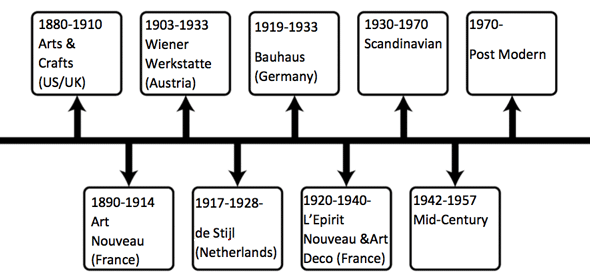
Modernism was born in the early 1900s and continued through the 1960s. It refers to a global movement that reexamined values, society, and the human experience in modern industrial life after the First World War.
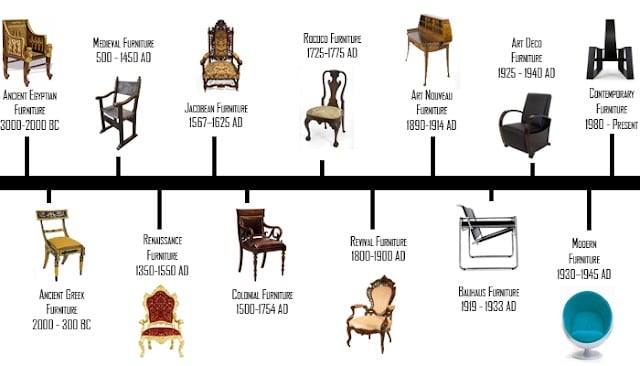
Before the 19th century, furniture design was often elaborate, ornate, and not particularly functional. Fabrics were expensive and crafted by hand by artisans—beautiful, yes, but not economical for people rebuilding their lives after a world war. Modern design stepped in with more practical methods of construction, new flexible materials, and a lighter, more streamlined feel. Thinking shifted from the decorative Art Nouveau of the 1920s to accessible, functional belongings. People were looking toward the future.
Several influences evolved in furniture design, and the materials tell the story: plastics, wood veneers, steel tubing—pieces that, to me, felt like art.
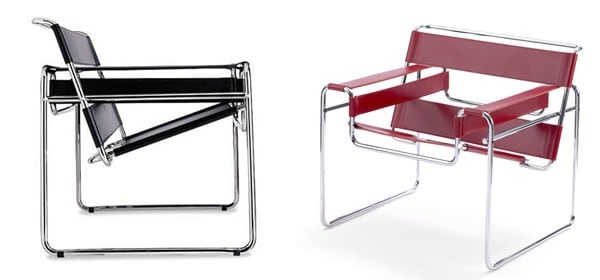
Some of my favorites were born out of the Bauhaus School of Design in Germany. The Wassily Chair is too noteworthy not to mention. This piece was inspired by the tubular steel experiments of Marcel Breuer at the Bauhaus School around the same time period.
Continuing the story: the spirit of Modernism
What makes Modernism so compelling is that it wasn’t just a design trend—it was a cultural awakening. Designers, architects, and artists were united by a shared belief that the world could be rebuilt with clarity, honesty, and purpose. They rejected excess and embraced simplicity, not as a limitation but as a form of liberation.
Furniture became lighter, both visually and physically. Lines were clean, proportions balanced, and ornamentation stripped away. The goal was to create pieces that served everyday life with dignity and beauty. Homes were no longer filled with heavy, imposing furniture meant to impress; instead, they became spaces designed to support living—real living.
This era also introduced the idea that furniture could be mass-produced without sacrificing quality or aesthetic value. Designers experimented with new manufacturing techniques, making good design accessible to more people than ever before. It was democratizing, empowering, and deeply optimistic.
The Bauhaus, in particular, championed the marriage of art and industry. Their philosophy—form follows function—became the backbone of Modern design. Chairs, tables, and lighting were treated as functional sculptures. Every curve, every angle, every material choice had intention behind it.
Breuer’s Wassily Chair, for example, wasn’t just a chair. It was a declaration: that beauty could be found in simplicity, that industrial materials could be elegant, and that design could be both modern and timeless.
Why Modernism still matters
Modernism continues to influence the way we design and live today. Its principles—simplicity, functionality, honesty in materials—are woven into contemporary interiors, architecture, and product design. When you walk into a home with clean lines, open spaces, and thoughtfully chosen furnishings, you’re experiencing the legacy of Modernism.
It taught us that design is not merely decoration; it is a reflection of how we think, how we live, and what we value.
And for those of us who adore Mid-Century and Post-Modern styles (myself included), Modernism is the foundation that made those movements possible. It set the stage for the playful curves, bold colors, and sculptural forms that would follow.